
Professional ChatGPT Training for Canadian Employees
AI tools are becoming part of everyday work. The practical challenge is helping employees use them thoughtfully, consistently and effectively. JimmyAI provides workplace-focused ChatGPT and AI training that helps Canadian organizations build useful skills without losing sight of privacy, quality and human judgment.

From small businesses to larger organizations, Canadian teams are looking for ways to make routine work clearer and more efficient. A well-structured training session gives employees a place to learn the basics, try practical examples and ask questions about the work they actually do. It also gives leaders a chance to establish sensible expectations for reviewing AI-assisted work and protecting confidential information.
Live Online AI Employee Training — $299.00 CAD Per Person
$299.00
Per person
Three hours of live online AI employee training, focused on practical ChatGPT use in the workplace.
The follow-up gives participants time to use what they learned, then return with real questions about prompts, workflows or AI-assisted tasks. It is a focused follow-up call, not unlimited consulting or a second three-hour course.
- Live, interactive online instruction
- Practical prompting and workplace examples
- Guidance on checking AI-generated work
- Responsible use, privacy and human review
- Questions during the training session
- Follow-up call approximately two weeks later
Why Canadian Organizations Invest in AI Employee Training
Access to an AI tool does not automatically create confident or consistent use. Employees may be unsure how to ask a useful question, how much context to provide, or when an AI response needs careful checking. Without shared habits, one person may use AI regularly while another avoids it altogether. Training helps close that gap with a common starting point and practical examples.
For Canadian workplaces, the conversation also needs to include responsible handling of information. Employees should understand that convenience does not remove the need for judgment. Training can help teams think about what information belongs in a prompt, how to review an answer, and when a person should make the final decision. These are practical habits that support better adoption across different departments.
Practical productivity
Employees can explore ways to use ChatGPT for first drafts, summaries, brainstorming, research preparation, meeting follow-up and other information-based tasks. The goal is to make everyday work more manageable while keeping people responsible for the final result.
More confident teams
A live session gives participants a chance to see examples, try their own prompts and ask questions in plain language. This reduces the intimidation that can come with a new tool and helps employees understand where AI is useful.
Better review habits
Useful AI training includes quality control. Participants learn to check details, identify uncertainty and edit AI-assisted work so that it matches the organization's needs, voice and standards.
Shared workplace language
When a team learns common concepts such as context, instructions, constraints and review, it becomes easier to discuss AI use with managers and colleagues. That shared language can support thoughtful adoption across roles.
Online AI Training for Distributed Canadian Teams
Live online delivery can be useful when employees work from different offices, work remotely or cannot gather at one location. Participants can join from their usual workspace and follow the same guided instruction. The session can address general workplace applications while leaving room for questions about the types of tasks participants handle each day.
Online learning is most valuable when it is active rather than passive. Participants should have opportunities to see a prompt built step by step, compare a vague request with a clearer one and discuss how to check an output. That is why the three-hour package is presented as live training, with a separate follow-up call approximately two weeks later. The gap gives employees a chance to test their new habits before asking follow-up questions.
Flexible participation: Teams can attend without arranging a shared physical venue or asking everyone to travel.
Real workplace context: Employees can bring questions related to writing, planning, communication, information gathering and other appropriate work tasks.
Practical follow-through: The included follow-up call creates a natural checkpoint after people have tried the techniques in their own work.
Human judgment stays central: AI can assist with drafts and ideas, but employees remain responsible for accuracy, decisions and appropriate use.
In-Person AI Training Workshops for Company Teams
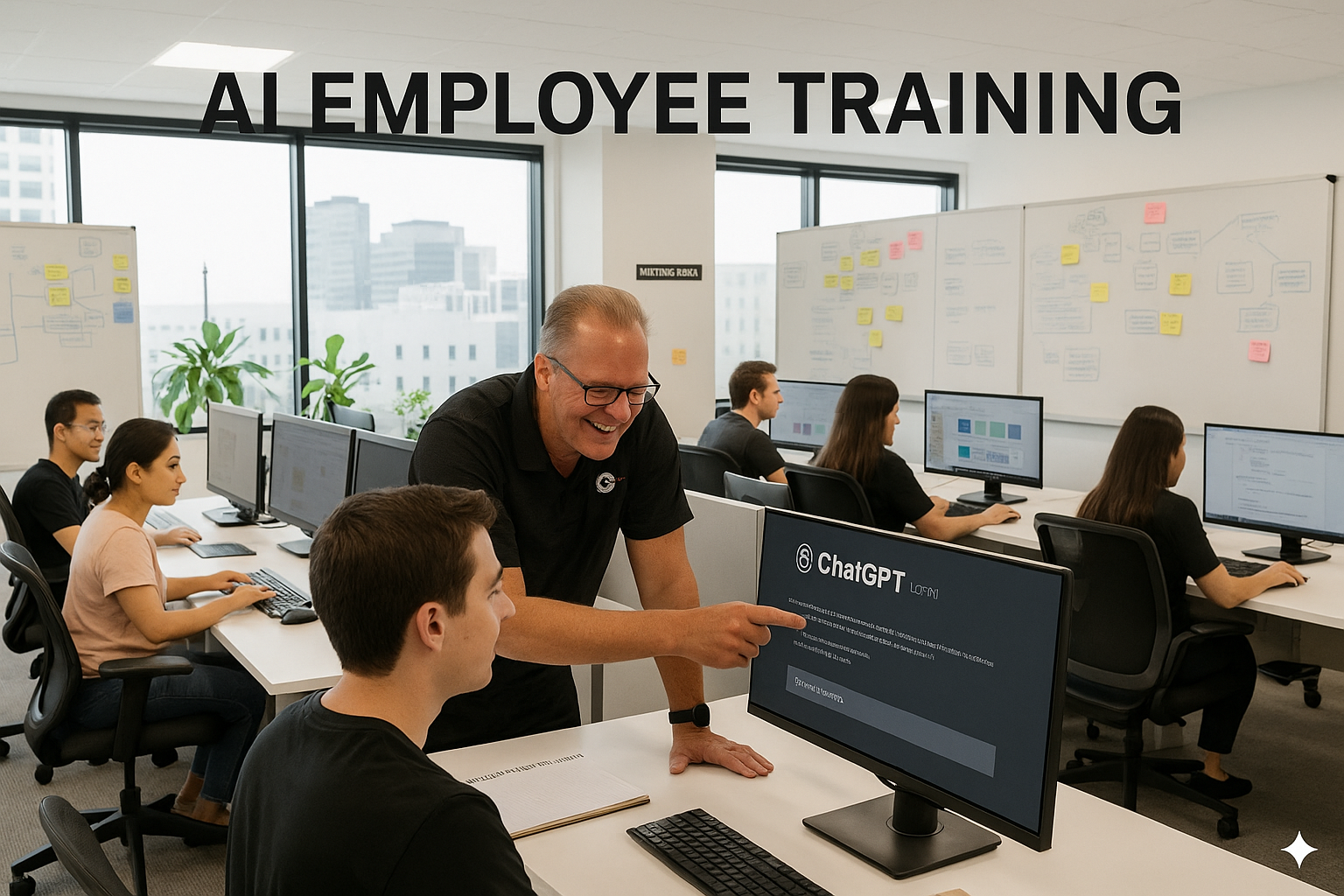
Some organizations prefer an in-person workshop because employees can learn together, compare ideas and discuss how AI relates to different roles. A shared session can help a group identify repetitive work, consider where AI assistance may fit and talk through questions in the same room.
Whether a team learns online or in person, the most useful training connects concepts to real work. The page's online package is a clear option for individuals and distributed teams, while organizations seeking a group workshop can contact JimmyAI to discuss their needs and preferred delivery format.
Interactive group learning
Participants can learn from questions raised by colleagues in different roles and departments.
Role-aware discussion
Examples can be discussed in terms of the kind of communication, planning or information work a team performs.
Core ChatGPT and AI Skills for Employees
Effective workforce development is not only about producing a faster draft. It is about understanding how to give an AI tool a useful task, how to guide the interaction and how to decide whether the response is good enough to use. JimmyAI's practical approach keeps these skills connected to ordinary workplace situations.
Prompting with purpose
Employees practise stating the task, audience, desired format and relevant context so that the tool has a clearer direction.
Editing and verification
Participants consider how to check facts, tone, calculations and missing details before sharing AI-assisted work.
Workflow thinking
Teams identify tasks where AI may assist with a first step, while deciding which parts still require human review and approval.
Responsible use
Employees discuss privacy, confidential information, bias, accuracy and the importance of following their organization's policies.
Training for Small Businesses and Larger Teams
Smaller businesses may want employees to save time on communication, planning and research without adding a complicated technology project. Larger teams may need a consistent baseline so that departments approach AI-assisted work with similar expectations. A live training session can be a practical first step in either situation.
The online package is priced at $299.00 CAD per person and includes three hours of live training plus the bonus follow-up call approximately two weeks later. That structure gives participants a clear learning session and a defined opportunity to return with questions after trying the material. It also keeps the offer straightforward: one person, one three-hour live session and one included follow-up call.
Organizations should select examples that fit their own work and should continue to apply their normal privacy, approval and quality-control practices. AI training is most useful when it supports the knowledge employees already have rather than pretending a tool can replace that knowledge.
A Simple Path to Getting Started
- Choose the online option: Register one participant for the three-hour live online AI employee training package at $299.00 CAD per person using the secure Stripe checkout button.
- Attend the live session: Participants learn practical ChatGPT and AI techniques, ask questions and consider how the ideas relate to their work.
- Use the skills: Employees have approximately two weeks to try the prompting, review and workflow ideas in appropriate workplace situations.
- Join the follow-up call: JimmyAI reconnects approximately two weeks later so participants can discuss questions and areas that need more guidance.
Build AI Skills Before the Gap Gets Wider
AI tools are changing how people approach writing, information and routine knowledge work. Employees do not need hype; they need clear examples, time to practise and a sensible way to ask questions when they begin using new techniques. A structured training session helps turn uncertainty into a practical learning process.
JimmyAI's three-hour online training is designed for Canadian employees who want workplace-focused guidance. The included follow-up call approximately two weeks later recognizes that useful questions often appear after training, when people have had an opportunity to apply what they learned. If your team is ready to build practical AI confidence, register for the online training package today.
Ready to Train Your Canadian Team?
Get three hours of live online AI employee training for $299.00 CAD per person, plus a bonus follow-up call approximately two weeks later.
Register for Online Training — $299Training + two-week follow-up call included. The follow-up is a focused included call, not unlimited consulting.
JimmyAI helps Canadian employees build practical AI skills for the work they do every day.